
Compass
Why Have People Never Stopped Reading the Stars?
A short history of astrology: from prediction to a mirror for questions
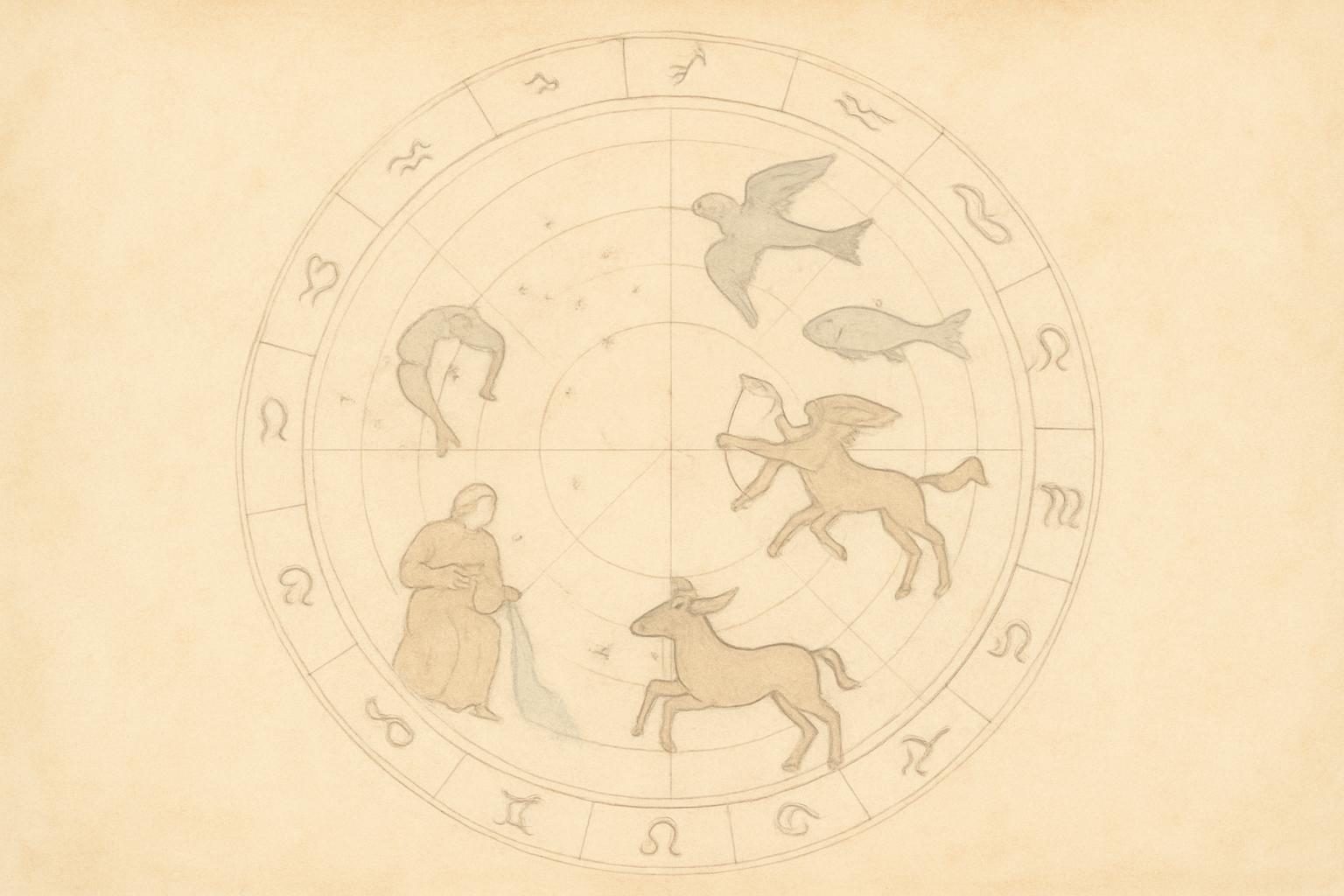
Astrology is often dismissed as superstition. Its history nevertheless reveals a long tradition of people looking upward and asking who they are.
Look up at the night sky. Searching the arrangement of stars for meaning is an astonishingly old human practice. Astrology's origins reach back to Mesopotamia in the late second millennium BCE. Babylonian priests recorded eclipses and planetary movements, linking them to good or ill fortune for the kingdom. At this stage, astrology was not for individuals. It was a form of political observation for the state and its king.
Horoscopic astrology, asking the stars about an individual's fate, is generally thought to have emerged later in Hellenistic Egypt. Greek geometric ideas of the cosmos met Babylonian observational records, producing the idea of mapping the structure of the universe onto the personal coordinates of a birth date. Ptolemy's second-century Tetrabiblos is known for organizing this system theoretically. Astrology was not clearly separated from astronomy then. Measuring the stars and finding meaning in them were two parts of the same intellectual practice.
As the Roman Empire declined, this knowledge receded in the West but was richly preserved in the Islamic world. Between the eighth and thirteenth centuries, scholars in Baghdad and Cordoba translated Greek astronomical texts and developed them with their own observational techniques. Astrology, astronomy, medicine and alchemy still shared loosely connected ground. Through this route, knowledge of the stars returned to medieval European universities in a kind of reimportation.
Astrology and astronomy parted more clearly during the Scientific Revolution. Interestingly, Kepler, a central figure in that transition, continued working as a court astrologer. Skeptical of many astrological claims, he nevertheless did not entirely abandon the idea of some harmony between celestial movement and earthly events. As astronomy became an independent science of observation and laws, astrology remained outside academic science as a language of meaning and symbols.
In the twentieth century, astrology attracted renewed attention in an unexpected way, through perceived affinities with Jungian archetypes. Jung himself did not endorse astrology as a complete system. Yet his concepts of the collective unconscious and archetypes resonated with ways of reading the qualities symbolized by the sun, moon and planets: reason, emotion, impulse and responsibility. A shift from fortune-telling toward a language for reflection may be one reason astrology has endured.
Whether astrology should be treated as science remains contested. The criticism that its claims do not withstand statistical testing is persistent and legitimate. But another question remains: why have people wanted for millennia to see themselves in the stars? Perhaps they seem to seek answers while actually seeking tools for asking questions. Looking at the sky on the day of one's birth may be less about correct prediction than about casting a little light on less visible parts of oneself.
FAQ
- Were astrology and astronomy originally the same thing?
- They were not clearly distinguished in antiquity and the Middle Ages. Their separation developed from the Scientific Revolution onward.
- Has astrology been scientifically proved?
- Statistical testing has not found convincing evidence supporting its claims, and many scientists judge it negatively.
- Did Jung believe in astrology?
- There is no clear record of Jung endorsing astrology as a complete system, though his archetypes are often discussed as having affinities with its symbolism.
ABC Editorial Team
Editorial team